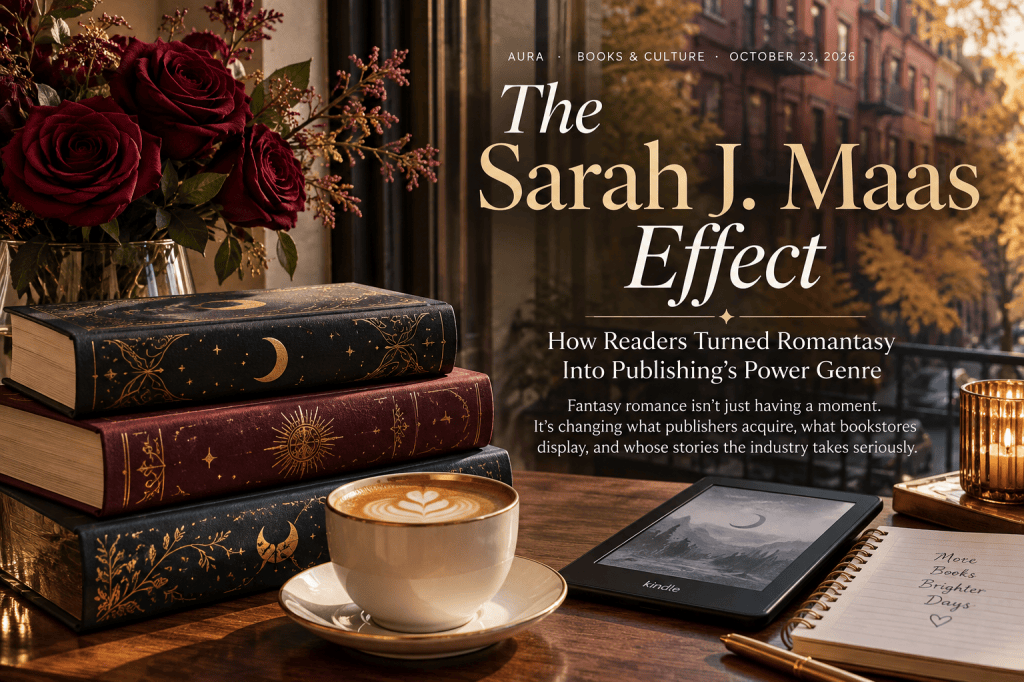
Fantasy romance isn’t just having a moment. It’s changing what publishers acquire, what bookstores display, and whose stories the industry takes seriously.
There was a time when telling someone you loved fantasy romance came with a little explaining. Yes, there were dragons. Yes, there was magic. Yes, people fell in love. And no, the romance did not somehow make the story less intelligent, less meaningful, or less worthy of being taken seriously.
Fast-forward to 2026, and the publishing industry seems to have discovered what readers have known for years: women who love fantasy are a force to be reckoned with. And if you want to understand how we got here, we need to talk about Sarah J. Maas. Not because she invented romantasy. She didn’t. But because she helped turn it into a cultural and commercial phenomenon that publishers can no longer treat as a niche interest.
After spending the last several weeks making my way through Throne of Glass and diving headfirst into Crescent City, I understand exactly why.
First, Romantasy Is More Than Romance With Dragons
Romantasy isn’t simply a love story with a magical setting. At its best, the genre combines the emotional intensity of romance with the scale and imagination of fantasy. We’re talking political alliances, ancient histories, impossible choices, magical systems, found families, and characters who are asked to sacrifice everything for the people they love. And yes, sometimes there are dragons.
The romance matters because the relationships matter. They influence decisions, create consequences, and often determine the fate of entire worlds. For years, traditional fantasy and romance were treated as separate categories, with different audiences and different expectations. Romantasy challenges that distinction. Readers don’t necessarily want to choose between an elaborate fantasy world and a deeply emotional love story. We want both.
The Sarah J. Maas Effect
Sarah J. Maas has created three major fantasy series: Throne of Glass, A Court of Thorns and Roses, and Crescent City. Each offers something different. Throne of Glass builds from a young assassin’s story into an enormous epic about kingdoms, sacrifice, loyalty, and destiny. A Court of Thorns and Roses places romance and personal transformation at the center of a richly imagined fae world. Crescent City takes fantasy into a modern urban setting, mixing supernatural politics, mystery, friendship, and romance.
What connects them is the way Maas makes readers emotionally invested. And I mean invested. The kind of invested where you finish a book, stare at the wall for a few minutes, and immediately need to discuss what just happened with someone who understands.
I recently finished Throne of Glass, and while I absolutely thought parts of the journey were longer than necessary, the ending made it worthwhile. Five stars. The sacrifices, the friendships, the happy ending, the wedding bells. After everything those characters endured, I wanted every bit of that happiness.
Then I started House of Earth and Blood. And that book? Ten stars, if Goodreads would let me. I loved the mystery, the emotional stakes, and the way seemingly unrelated details gradually became important. By the ending, I was completely sold.
You’re not simply reading to find out whether two characters get together. You’re reading because you’ve become attached to an entire world. And once that happens, you don’t just want the next book. You want the special edition. The sprayed edges. The fan art. The theories. The midnight release. The conversation. That’s where the publishing industry started paying attention.
BookTok Didn’t Create Romantasy. It Gave Readers a Megaphone.
Readers were already recommending fantasy romance in online forums, Goodreads groups, blogs, YouTube videos, and book clubs long before TikTok became a major discovery platform. What BookTok changed was visibility.
A reader could post a thirty-second video about a fictional character who destroyed her emotionally, and suddenly thousands of people wanted to experience that same heartbreak. The recommendations felt personal. They weren’t polished advertisements written by a marketing department. They were readers saying, essentially, You need to read this because I haven’t been the same since. And other readers listened.
Of course, not every viral recommendation delivers. Hype can create unrealistic expectations, and popularity isn’t the same thing as literary quality. But readers gained influence over which books received attention, which backlist titles returned to bestseller conversations, and which genres became commercially attractive. The audience stopped waiting for the industry to tell it what mattered. It started telling the industry.
The Business of Beautiful Books
Let’s discuss special editions. Because apparently owning a book is no longer enough. We need the hardcover. Then the exclusive hardcover. Then the version with illustrated endpapers. Then the sprayed edges. Then the signed edition. And occasionally, we need to pretend we’re purchasing it for a perfectly reasonable reason.
I say this as someone who genuinely loves beautiful books. There’s an artistry to a thoughtfully designed edition. A book can be both a story and an object worth collecting. But special-edition culture also reveals how publishers are responding to romantasy readers. They’re no longer selling only the reading experience. They’re selling collectibility, community, aesthetics, and the emotional attachment readers develop to fictional worlds.
Independent subscription companies, major retailers, and traditional publishers have all recognized that demand. The result is an increasingly competitive market of exclusive covers, redesigned series, limited printings, and collector-focused releases. For readers, that’s exciting. It’s also expensive. A $40 hardcover doesn’t automatically make a book better than the paperback you borrowed from the library. Although I reserve the right to admire both.
Why Publishers Are Paying Attention
The commercial success of romantasy influences acquisition decisions, marketing budgets, and which authors receive major campaigns. October 2026 reporting in the Financial Times highlighted how Sarah J. Maas, BookTok, and romance-forward fantasy have helped reshape publishing’s priorities.
Entangled Publishing, known for its romantasy success, has reportedly attracted a valuation of approximately $400 million. That is a reported business valuation, not annual sales, and it should not be confused with the size of the entire romantasy market. Still, it illustrates how seriously investors are taking a category once treated as a specialized corner of publishing.
When a genre becomes profitable, publishers want more of it: more acquisitions, more elaborate launches, more books marketed as the next Fourth Wing or A Court of Thorns and Roses. But readers don’t necessarily want the next version of something they’ve already read. We want new voices, new mythology, different cultures, different relationships, and different ways of imagining the impossible. The industry has to invest in originality rather than endlessly reproducing whatever worked last year.
The Women Behind the Numbers
Romantasy is often discussed as a trend driven by female readers. Sometimes the language surrounding that observation is dismissive, as though women becoming deeply enthusiastic about something makes it less serious. We’ve seen versions of this conversation before with romance novels, young adult fiction, and fandom culture.
But enthusiasm is not a weakness. Neither is emotional storytelling. There’s nothing inherently less sophisticated about a fantasy novel because love plays an important role in its plot. Readers can appreciate complex political worldbuilding and an unforgettable romantic relationship. Our reading lives don’t have to fit into one respectable category. And we certainly don’t need permission to enjoy the books that make us happy.
What Happens After the Romantasy Boom?
Every major publishing trend eventually faces the same question: what happens when the excitement settles? Some books will fade from conversation. Some authors will struggle to repeat a breakout success. Some readers will move on to different genres. That’s normal.
But I don’t think romantasy’s lasting impact will be measured only by how many dragon-covered hardcovers appear on bestseller lists. Will publishers continue investing in fantasy stories centered on women? Will new authors receive the same opportunities as established names? Will bookstores maintain space for stories that cross genre boundaries? Will readers continue discovering books through one another rather than relying exclusively on major campaigns? A publishing boom is one thing. A lasting change in whose stories are valued is something else entirely.
And Then There’s the Joy of Reading
I could spend another thousand words discussing sales, publishing strategy, and collector editions. But the reason I care about any of this is much simpler. I love reading. I love finding a story that makes me forget to check my phone. I love discovering a character who surprises me. I love the moment a complicated plot finally clicks into place. And I love finishing a book knowing I’ll be thinking about it for days.
That’s what happened to me with Throne of Glass. That’s what happened again with House of Earth and Blood. It’s not just about romance. It’s not just about fantasy. It’s about stories that make readers feel something extraordinary. If the publishing industry is finally recognizing the value of that experience, wonderful. Readers have known all along.
Did Sarah J. Maas introduce you to romantasy, or were you already reading fantasy romance before the genre became a phenomenon? And which fictional world would you move into if you had the chance? I’m still considering my options.
With love and an ever-growing TBR,
Aura
Sources and Further Reading
Financial Times, October 2026 coverage of Sarah J. Maas, BookTok and publishing economics; Publishers Weekly coverage of fantasy acquisitions and special editions; Circana BookScan U.S. print-book sales tracking. Reported business valuations are not independently audited market-size figures.


Leave a Reply